

Quick answer: To write a strong scholarship SOP, start by checking the scholarship’s official instructions. Then explain your academic background, relevant achievements or experience, reasons for choosing the programme, and your plans. Where the scholarship asks about development impact, leadership, community involvement, or financial circumstances, address those points directly. Keep the statement within the required word or character limit and make sure the content is your own work.
A strong Statement of Purpose (SOP) explains academic background, reasons for choosing the programme, relevant experience, and future goals. However, there is no single SOP format that applies to every scholarship. Each scholarship provider or university can set its own questions, word limits, and requirements.
For example, Oxford states that applicants must follow the requirements given on the relevant course page, while DAAD requires applicants to explain why their proposed study or research is important for their academic and professional development. In this guide, we will explain how you can write an SOP for any scholarship opportunity.
Key Takeaways
- Follow the scholarship’s official SOP instructions and word limit.
- Explain your academic background, relevant experience, and future goals.
- Tailor your SOP to the specific scholarship and programme.
- Use specific examples instead of generic claims or achievements.
- Make sure the final statement is accurate, original, and based on your own experiences.
What Is an SOP for a Scholarship?
A Statement of Purpose is an application document used by some universities and scholarship programmes to understand an applicant’s academic interests, motivation, experience, and future plans.
However, not every scholarship uses the same type of statement. Some programmes call it a Statement of Purpose, while others use terms such as a personal statement, motivation letter, study plan, or Statement of Grant Purpose.
What Are the SOP Formatting Requirements for Scholarships in 2027?
There is no universal formatting standard for scholarship SOPs in 2027.
Do not automatically use an 800–1,000-word limit, Times New Roman, 12-point font, 1.5 line spacing, one-inch margins, or a seven-paragraph structure unless the specific scholarship or university tells you to do so.
Official requirements vary considerably. For example, Oxford courses can set different statement limits. One Oxford course currently requires a Statement of Purpose of 500–700 words, while another requires a maximum of 1,000 words.
DAAD’s general scholarship guidance states that its motivation letter should be a maximum of two pages for the relevant application guidance.
The rule is simple: follow the instructions for your specific scholarship or programme.
Before writing, check:
- Required word or character limit
- Questions or topics you must address
- Required document format
- Whether the statement must be uploaded separately or entered into an online form
- Whether additional documents, such as a study plan or research proposal, are required
What Should You Include in a Scholarship SOP?
Instead of following a fixed seven-paragraph formula, organise your SOP around the information the scholarship actually asks for.
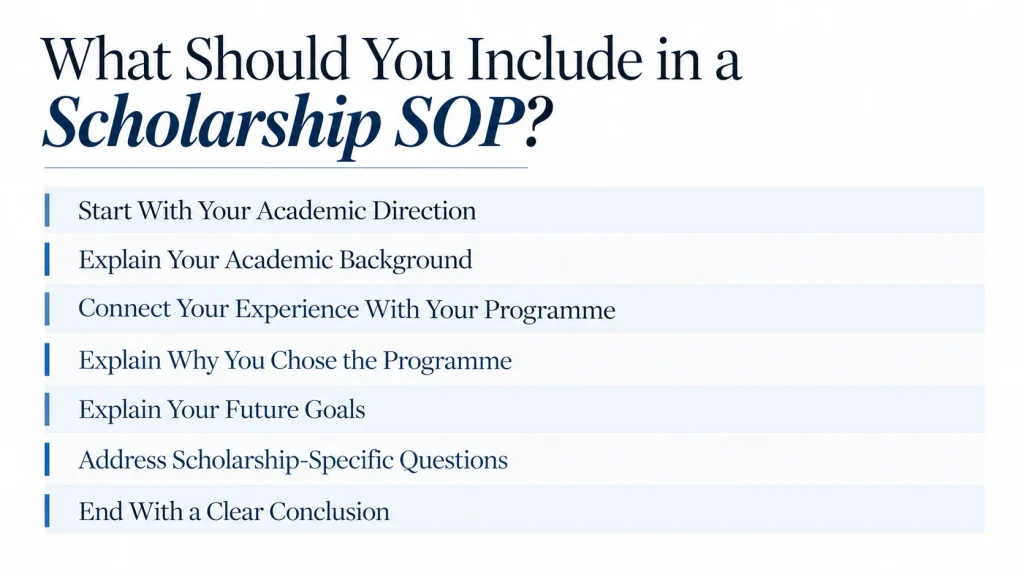
1. Start With Your Academic Direction
Your opening should quickly establish who you are academically and what you want to study.
Explain your academic field, your current stage of education, and the area you want to pursue. Avoid spending too much space on general statements that could apply to any applicant.
Your introduction should help the reader understand the direction of the rest of your statement.
2. Explain Your Academic Background
Use relevant academic experiences to show how you developed an interest in your chosen field.
You can discuss:
- Relevant coursework
- Research projects
- Academic achievements
- Major assignments or projects
- Technical or subject-specific skills
- Relevant academic challenges and what you learned from them
Use specific evidence where possible.
Oxford’s current guidance for certain programmes specifically asks applicants to discuss their academic history, relevant experience, motivation, and areas of academic interest.
3. Connect Your Experience With Your Programme
Your SOP should explain why the programme you are applying for makes sense for your academic or professional development.
Discuss relevant internships, employment, research, volunteering, projects, or other experiences when they directly support your application.
Do not list everything you have done. Select the experiences that help explain your academic direction.
DAAD’s official guidance, for example, asks applicants to explain why their proposed study or research is important for their further career and development and why they have chosen the particular country and host institution.
4. Explain Why You Chose the Programme
Avoid writing a generic statement that you want to study at a particular university because it is “world-class.”
Instead, identify the academic features that are genuinely relevant to your goals.
Depending on the programme, this could include:
- A particular area of study
- Relevant modules
- Research opportunities
- The programme’s academic focus
- A research environment
- A specific academic or professional pathway
Make sure these details are accurate and taken from the institution’s official information.
5. Explain Your Future Goals
Your SOP should make the connection between the proposed programme and your future plans clear.
Explain what you want to do after completing your studies and how the education or training will support those plans.
Some scholarship programmes specifically ask applicants to explain their future career plans. For example, the Commonwealth Scholarship Commission asks Master’s Scholarship applicants to provide their plans for the five years following the scholarship as well as their long-term career plans.
If a scholarship asks about development impact, explain the specific problem you want to address, who could benefit, and how you expect to apply your new knowledge.
For example, the Commonwealth Scholarship from Pakistan application asks applicants to explain expected development outcomes, implementation timeframes, beneficiaries, and how impact could be measured.
6. Address Scholarship-Specific Questions
Do not assume that every scholarship wants the same information.
Some scholarships may ask about:
- Leadership
- Voluntary activities
- Community impact
- Financial circumstances
- Development challenges
- Research plans
- Career plans
- Personal background
If the application specifically asks for these details, answer them directly.
For example, the Commonwealth Master’s Scholarship application asks applicants to discuss voluntary activities and opportunities to demonstrate leadership, as well as their personal background and potential development impact.
7. End With a Clear Conclusion
Your final paragraph should bring your academic background, programme choice, and future goals together.
Briefly explain why the scholarship or programme is important to your plans. Avoid introducing a completely new achievement or argument in the final sentence.
Keep the ending focused and relevant to the application.
How Should You Adapt an SOP for Bachelor’s, Master’s, and PhD Scholarships?
Your statement should reflect your academic level and the requirements of the specific programme.
Bachelor’s Scholarships
For undergraduate applications, focus on your academic interests, relevant achievements, activities, and reasons for pursuing the chosen field.
Do not present yourself as an experienced researcher if you are applying directly after school. Instead, explain how your academic experiences and interests have led you towards the field.
Master’s Scholarships
For Master’s applications, connect your previous degree, relevant experience, and proposed programme.
Explain what you have already studied or worked on and how the Master’s degree fits into your academic or professional development.
The Commonwealth Master’s Scholarship application, for example, asks applicants to provide a detailed study plan, career plans, personal information, and a Development Impact statement.
PhD Scholarships
For doctoral applications, research interests and research preparation are often particularly important.
The exact requirements vary by university and programme. Some programmes may require a separate research proposal, while others may ask the Statement of Purpose to focus on research interests and academic preparation.
For example, Oxford’s current guidance for one research programme asks applicants to provide a statement of research interests and explain how their background relates to the programme.
Always follow the specific PhD programme’s instructions rather than using a general SOP template.
What Mistakes Should You Avoid in a Scholarship SOP?
You must always avoid these things when working on an SOP
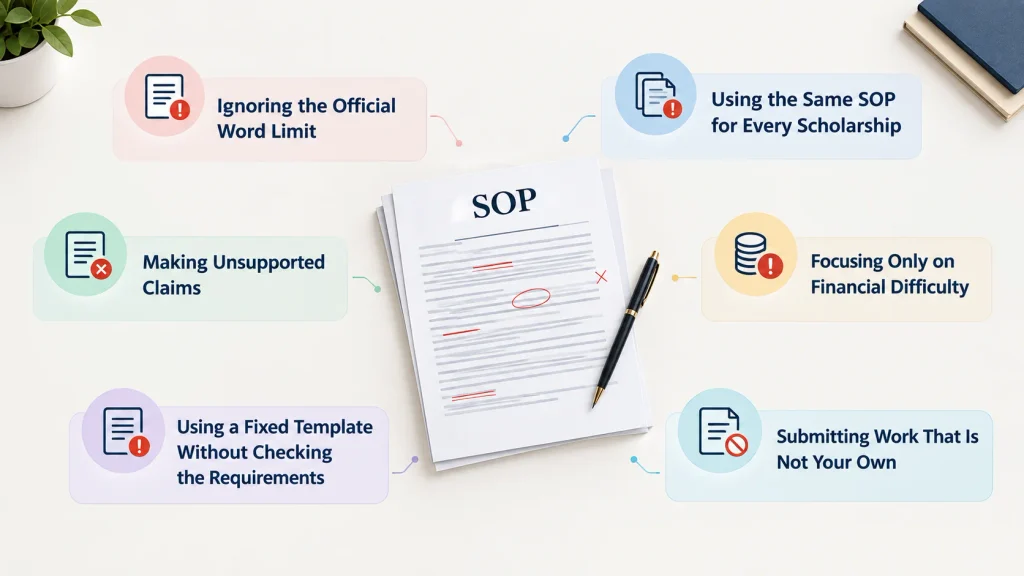
Ignoring the Official Word Limit
A statement that exceeds the required length can create a serious application problem.
Oxford states that if a Statement of Purpose or personal statement significantly exceeds the permitted length, it may be removed and the application may be considered incomplete.
Never assume that writing more will make your application stronger.
Using the Same SOP for Every Scholarship
Your academic background may remain similar, but your application should address the specific requirements of each scholarship.
Different programmes may ask completely different questions. A Commonwealth application, for example, includes specific requirements around development impact and career plans that would not automatically apply to every scholarship.
Making Unsupported Claims
Avoid statements such as “I am the best candidate” unless you immediately support your point with relevant evidence.
Instead, show your academic preparation, experience, achievements, and goals through specific examples.
Focusing Only on Financial Difficulty
Do not assume that financial need should be the central argument of every scholarship SOP.
Some scholarships may ask about financial circumstances, while others focus primarily on academic preparation, motivation, research, leadership, development impact, or other criteria.
Only discuss financial circumstances when the application specifically asks for them or when they are relevant to the required statement.
Using a Fixed Template Without Checking the Requirements
A generic seven-paragraph structure is not an official requirement for scholarship SOPs.
The correct structure depends on the questions and instructions provided by the scholarship or university.
Submitting Work That Is Not Your Own
Your statement should accurately represent your own experiences, qualifications, goals, and ideas.
Oxford states that its Statement of Purpose or research proposal must be entirely the applicant’s own work and notes that departments may screen statements using plagiarism-detection software.
Do not invent achievements, research experience, leadership positions, or personal circumstances to make your application stronger.
How Can You Make Your SOP More Specific?
Before submitting your SOP, check whether every major claim is supported by an example.
| Avoid Generic Statements | Use Specific Examples Instead |
|---|---|
| “I have strong leadership skills.” | Describe a specific leadership role, what you did, and the result. |
| “I am passionate about my field.” | Explain which academic experience, project, or subject developed your interest. |
| “This degree will help me change my community.” | Explain the specific problem you want to address and how the degree will help you work on it. |
| “I am a hardworking student.” | Mention a relevant academic achievement, research project, or experience that demonstrates your ability. |
| “This university is the best for me.” | Identify specific programme features, courses, or research opportunities that match your goals. |
Final Checklist Before Submitting Your Scholarship SOP
Before submitting, check the following:
- Have I followed the scholarship’s official instructions?
- Have I stayed within the required word or character limit?
- Have I answered every question asked?
- Have I explained my academic background clearly?
- Have I connected my experience to the proposed programme?
- Have I explained why I chose this programme or institution?
- Have I explained my future goals?
- Have I addressed scholarship-specific requirements such as leadership or development impact?
- Have I removed unsupported or exaggerated claims?
- Is the statement based on my own experiences and ideas?
- Have I proofread the final version?
Write an SOP That Reflects Your Academic Goals
A strong scholarship SOP does not need a complicated formula. It needs to answer the questions the scholarship or university has actually asked and connect your academic background, experience, programme choice, and future goals clearly. For Pakistani students preparing applications for international scholarships, careful research and accurate information can make the writing process much easier using trusted platforms like ScholarBee.
Frequently Asked Questions
How long should a scholarship SOP be?
There is no universal scholarship SOP length. The required length depends on the scholarship or university. For example, current Oxford programmes have different limits, including 500–700 words and a maximum of 1,000 words, while Fulbright’s Statement of Grant Purpose uses a 6,000-character limit for its U.S. Student Program.
Can I use the same SOP for different scholarships?
You can reuse accurate information about your academic background and experience, but you should adapt the statement to each scholarship’s requirements. Different programmes can ask for different information, so a generic SOP may fail to address important questions.
Should I mention my financial problems in the SOP?
Only if the scholarship or application asks about financial circumstances or the information is relevant to the required statement. Financial need is not a universal requirement for scholarship SOPs.
What is the most important part of a scholarship SOP?
There is no single section that is officially considered the most important for every scholarship. Your statement should address the criteria and questions specified by the programme. For example, Fulbright evaluates applications using factors including the proposed project, qualifications, and contribution to the Fulbright mission, while Commonwealth Master’s Scholarships require specific information about development impact and career plans.
Is a Statement of Purpose the same as a Personal Statement?
Not always. Universities and scholarship providers can use these terms differently. Some applications request a Statement of Purpose, while others request a personal statement, motivation letter, study plan, or another type of written response. Always check the terminology and instructions used by the specific programme.