


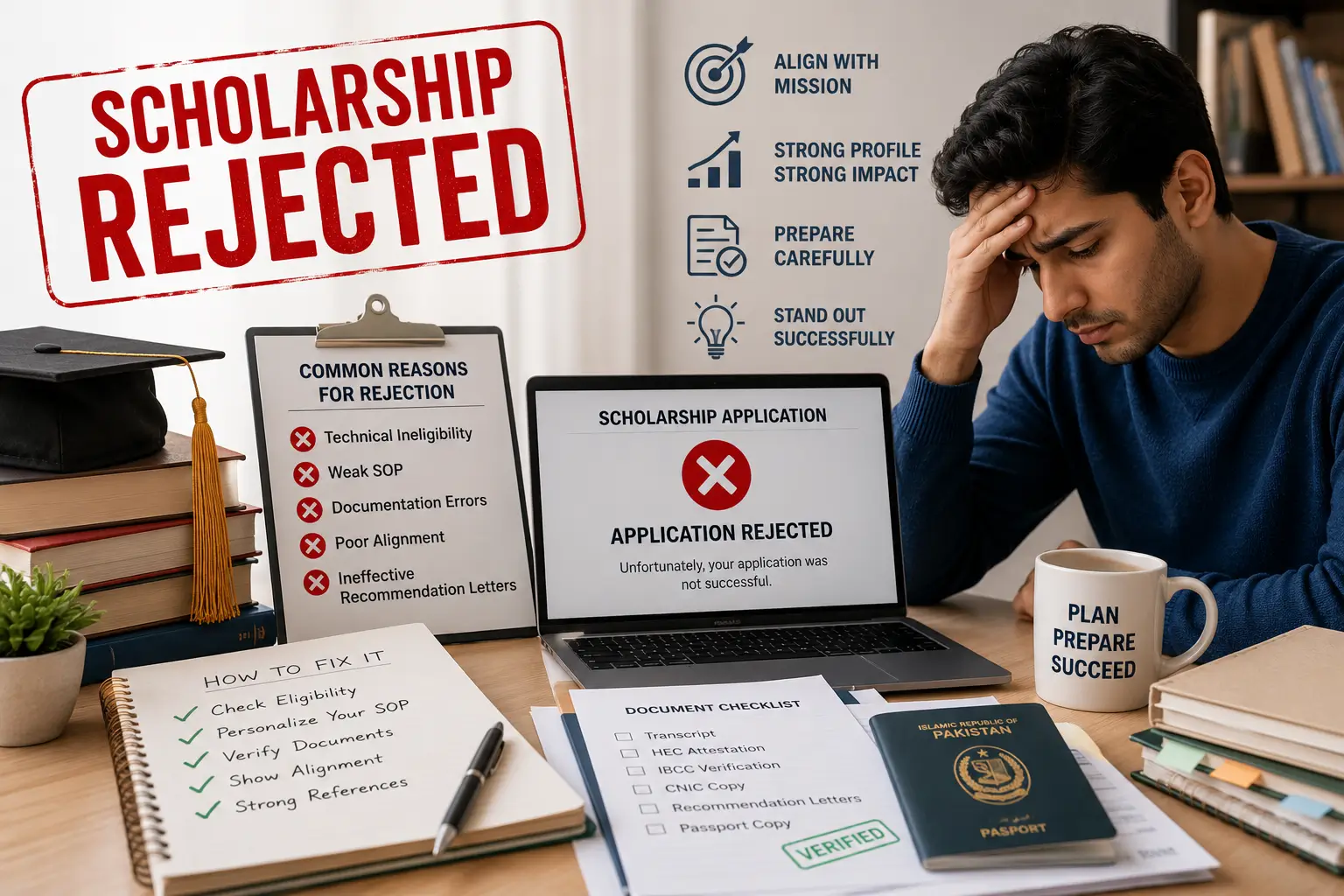
Scholarship applications are often rejected because of technical ineligibility, weak or generic Statements of Purpose, documentation errors, poor alignment with the scholarship’s mission, or ineffective recommendation letters. In many cases, rejection is not about a lack of merit but avoidable mistakes that can be identified and corrected before the next application cycle.
In the competitive landscape of 2026, committees move beyond simple GPA metrics. They prioritise a holistic evaluation of every candidate. If you faced a setback, you must audit your previous submission. Identify and rectify the “silent killers” that lead to disqualification.
Key Takeaways
- Automated filters (ATS) will reject applications that miss even one “hard” requirement, such as years of work experience or specific CGPA thresholds.
- Generic or AI-generated Statements of Purpose (SOPs) are easily identified by committees; successful SOPs must link your past in Pakistan to future global goals.
- For Pakistani students, HEC and IBCC attestation is non-negotiable; unverified documents are a leading cause of administrative rejection.
- You must demonstrate “fit” by showing how your chosen field of study aligns with the specific mission of the scholarship provider.
What are the Most Common Reasons for Scholarship Rejection?
Here are some critical reasons why many scholarships get rejected:
Why Does Technical Ineligibility Lead to Immediate Rejection?
Many Pakistani applicants overlook specific eligibility criteria. Global programs like Chevening, DAAD, or the Fulbright Commission have strict rules. For example, a program may mandate two years of post-graduation professional experience. If you apply with only 18 months, the automated Applicant Tracking System (ATS) triggers an immediate rejection.
To fix it, develop a comprehensive eligibility matrix. Cross-reference your age and degree level. Check your specific work experience against the 2026 guidelines. Do this before initiating the application.
Why Do Generic or Plagiarised SOPs Get Rejected?
The Statement of Purpose is your primary tool for advocacy. Utilising generic internet templates is a major red flag. AI-generated narratives often lack personal context. Reviewers identify these immediately. To fix this, your SOP must articulate a clear “theory of change”. Explain how your study abroad addresses a development challenge in Pakistan.
How Do Documentation and HEC Attestation Issues Cause Rejection?
Documentation errors like incomplete documents and attestation discrepancies are among the most common administrative reasons for rejection.
For Pakistani students, the attestation hierarchy is a common failure point. Submitting transcripts without the necessary stamps will result in administrative rejection. You must have verification from the Higher Education Commission (HEC) or IBCC.
If you are unsure about the verification process, following a detailed HEC attestation guide can help you avoid common mistakes that lead to administrative rejection. To fix it, adhere strictly to the scholarship documents checklist for Pakistani students. Ensure all digital scans are high-resolution and that the degree titles match your application exactly.
Why Do Generic Letters of Recommendation Weaken Your Application?
A generic recommendation letter provides little value because it does not demonstrate your unique strengths or leadership potential.
A “To Whom It May Concern” letter adds very little value. It should not just list your grades. Selection committees seek specific evidence of leadership. They want to see your character in action.
To fix it, brief your referees on the scholarship’s mission. Ask for a letter discussing your contribution to a specific project. Mention your resilience during a tough semester. This is far more persuasive than a standard template.
How Can You Fix Common Scholarship Application Mistakes?
Here is an analysis of rejection reasoning versus a professional solution:
| Primary Mistake | Professional Root Cause | The Strategic Fix |
|---|---|---|
| SOP Plagiarism | Lack of personal narrative | Use a bespoke [SOP Template #14] |
| Documentation Errors | Missing HEC/IBCC Attestation | Consult the [Checklist #15] |
| Poor Field Fit | Misalignment with Mission | Research the “priority fields” for Pakistan |
| Interview Failure | Lack of technical preparation | Review [Interview FAQ #18] |
What are the Strategies to “Rejection-Proof” Your Profile?
To elevate your application, you must adopt a professional mindset. Scholarships are essentially academic investments. The committee looks for a high return on that investment. They want to see your future leadership potential in Pakistan.
Before final submission, have your application reviewed by a successful alumnus. This helps identify “blind spots” in your logic. It improves your overall formatting. Does your transcript show a gap year? Do not leave it to the reviewer’s imagination. Use the “additional information” section. Explain these periods with professional transparency.
Ensure your chosen university is recognised by HEC Pakistan. This avoids future equivalency issues. Check that the host country also recognises the institution.
Get Professional Help
Align your goals with the scholarship’s mission and ensure professional-grade documentation. It is important to position yourself as a top-tier candidate for the 2026 intake. Take the next step in your journey and get expert guidance at ScholarBee.A platform designed to turn your next application into an acceptance.
Frequently Asked Questions (FAQs)
Can I reapply to a scholarship program after a previous rejection?
Absolutely. Most international programs encourage re-applicants, provided you can demonstrate significant professional or academic growth since your last attempt.
Does a low CGPA disqualify me from fully funded opportunities?
Not necessarily. Many programs, such as Turkiye Burslari or certain CSC tracks, utilise a merit-based, holistic approach where strong work experience and a compelling motivation letter can compensate for a lower CGPA.
Is the IELTS requirement mandatory even if my medium of instruction was English?
While some countries like the UK or Australia strictly mandate IELTS/TOEFL, others may accept an “English Proficiency Certificate” from your Pakistani university. Always verify the specific language requirements for 2026.
