


Quick answer: The best way to prepare for a scholarship interview in Pakistan is to know your application thoroughly, prepare several real examples of your achievements and challenges, understand the scholarship’s objectives, and practise answering questions aloud. Avoid memorizing complete answers. Instead, know the key points you want to communicate and explain them naturally. For competency-based questions, the STAR method—Situation, Task, Action, Result—can help you give clear and evidence-based answers.
To ace a scholarship interview in Pakistan, treat it as an opportunity to explain your experience, goals, and motivation clearly. Prepare structured answers with real examples, connect your study plans to your future goals, practice speaking out loud, and stay authentic rather than memorizing complete scripts. Official Chevening guidance, for example, recommends using the STAR method to structure competency-based answers and focusing on specific evidence from your experience.
This guide explains what scholarship interview panels may look for, common scholarship interview questions, how to prepare, and practical tips for Pakistani students applying for major international scholarships in 2027.
Key Takeaways
- Review your complete scholarship application before the interview.
- Prepare real examples that demonstrate leadership, problem-solving, teamwork, or impact.
- Use the STAR method for competency-based questions.
- Research the specific scholarship and understand how your study plans fit its objectives.
- Practise speaking aloud instead of memorizing complete scripts.
- Be authentic and make sure your interview answers are consistent with your application.
What Do Scholarship Interview Panels Look For?
Scholarship interview panels generally want to understand your motivation, experience, goals, and potential contribution. However, the exact criteria and interview process depend on the scholarship.
For example, Chevening’s official guidance emphasizes qualities such as leadership, impact, networking, motivation, and clear career goals. Applicants are encouraged to connect their previous experiences with their future plans and explain how Chevening will help them achieve those goals.
For the Fulbright Program in Pakistan, USEFP states that the program considers merit broadly, including academic achievement, leadership potential, and a commitment to contributing to Pakistan’s future. The 2027 Fulbright Student Program is for graduate study in the United States and is funded by the U.S. government in partnership with the Government of Pakistan.
This means your interview preparation should focus on your own experience rather than trying to guess a particular panelist’s personality or behavior.
Chevening Interview Focus
Chevening interviews are conducted by panels at British embassies and high commissions. For the 2027–28 cycle, shortlisted applicants are scheduled to be interviewed between March and April 2027. Candidates must also upload their required documentation at least seven working days before their interview.
Chevening recommends using the STAR approach for competency-based questions. The official guidance also stresses giving specific examples rather than simply claiming that you have a particular skill.
Fulbright Interview Focus
The Fulbright Program in Pakistan is administered by the United States Educational Foundation in Pakistan (USEFP). For the 2027 Fulbright Student Program, USEFP says the program considers academic achievement, leadership potential, and an applicant’s commitment to contributing to Pakistan’s future.
Do not assume that every Fulbright interview follows the same format every year. Applicants should follow the instructions and communications provided by USEFP for their specific cycle.
What Are the Most Common Scholarship Interview Questions?
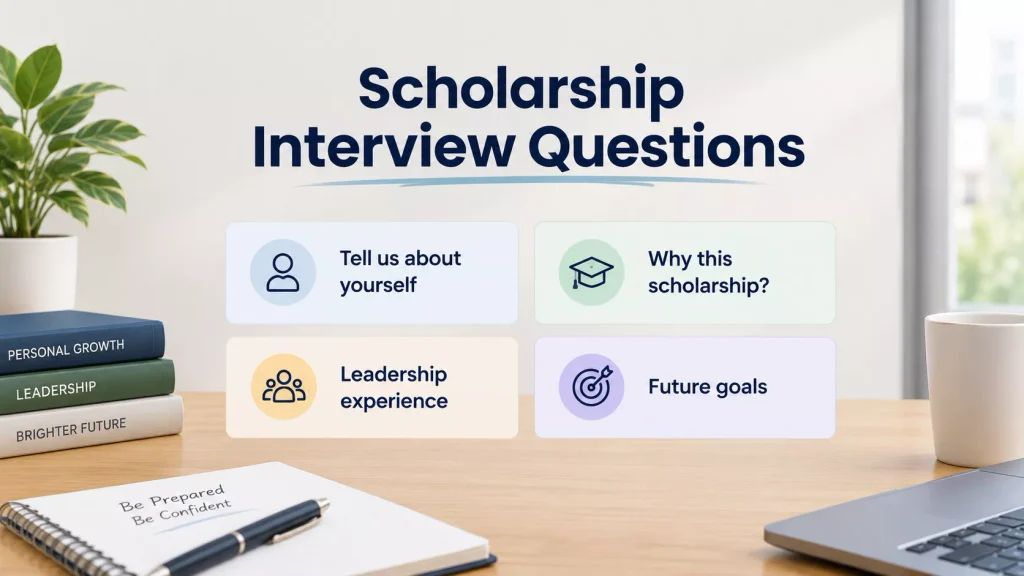
Use the following table as a quick preparation guide for a scholarship interview.
| Common Interview Question | What the Panel Wants to Understand | How to Prepare Your Answer |
|---|---|---|
| Tell us about yourself. | Your academic or professional background, key experiences, motivation, and future direction. | Give a concise overview of your background, mention one or two relevant experiences, and explain how they connect to your current goals. |
| Describe a time you led a team or overcame a challenge. | Evidence of leadership, problem-solving, decision-making, and your personal contribution. | Use the STAR method: Situation, Task, Action, and Result. Focus on what you personally did and the outcome. |
| Why did you choose this scholarship? | Whether you understand the scholarship and how it fits your academic and professional goals. | Research the scholarship’s objectives and explain why its programme, network, study opportunity, or other features are relevant to your plans. |
| What will you do after your studies? | Your career direction and how you intend to apply what you learn. | Explain your career goals, the problem or field you want to work on, and how your degree will support your plans. |
How Should You Prepare for a Scholarship Interview?
The strongest preparation combines application review, scholarship research, and repeated speaking practice.
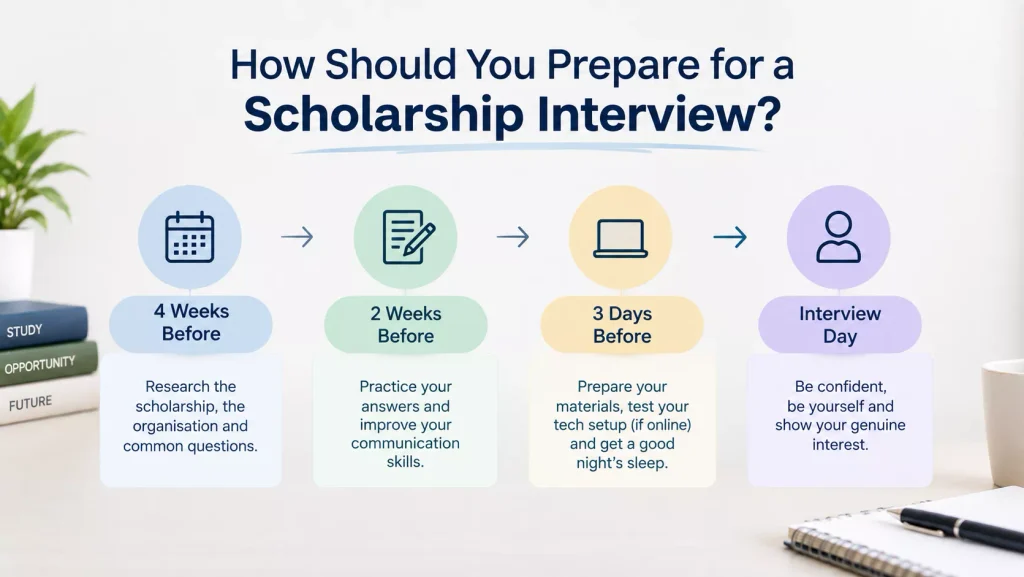
4 Weeks Before the Interview
Read your entire application again.
Review your:
- personal statements;
- CV;
- academic history;
- work experience;
- leadership examples;
- volunteer activities;
- research plans; and
- career goals.
Be prepared to explain anything you included in your application. Your answers should remain consistent with what you submitted. If you have previously received a scholarship rejection, reviewing common mistakes can also help you identify areas to improve before your next application. See Why your scholarship application gets rejected and how to fix it for additional guidance.
Also research the scholarship’s official objectives, selection criteria, interview guidance, and current requirements.
2 Weeks Before the Interview
Start practising aloud.
Reading answers silently is not enough. Ask a friend, mentor, teacher, or former scholarship recipient to conduct mock interviews.
Practise questions such as:
- Tell us about yourself.
- Why did you choose this programme?
- Why this scholarship?
- What is your greatest achievement?
- Tell us about a leadership experience.
- Describe a difficult challenge and how you handled it.
- What are your career goals?
- How will your studies contribute to your field or community?
Record some practice sessions if possible. This can help you notice answers that are too long, unclear, or overly rehearsed.
3 Days Before the Interview
Do not try to rewrite your entire application at the last minute.
Instead, review your key examples, academic plans, career goals, and important details from your application.
If your interview is online, test your internet connection, camera, microphone, and surroundings. If the scholarship provides specific instructions about the interview format or technology, follow those instructions.
For an in-person interview, confirm the location, required documents, arrival time, and any instructions provided by the scholarship organisation.
Interview Day
Keep your preparation simple.
Dress professionally, arrive on time, and keep any documents that the scholarship organisation has specifically asked you to bring.
During the interview, listen carefully to each question before answering. Maintain natural eye contact and speak clearly. If you need a moment to think, it is better to pause briefly than to rush into an unclear answer.
What Are the Best Scholarship Interview Tips?
The best scholarship interview strategy is to be prepared without sounding rehearsed.
Use Real Examples
Instead of saying, “I am a strong leader,” explain a situation where you actually demonstrated leadership.
For example, describe a project you managed, the problem you faced, the decisions you made, and the result.
Focus on Your Own Contribution
When describing a group project, explain what you did.
Chevening’s official guidance specifically advises applicants using STAR to focus on their own actions and measurable results.
Do Not Memorize Complete Scripts
Knowing your main points is useful. Memorizing every sentence can make your answers sound unnatural and can make it harder to respond when the panel asks a follow-up question.
Recent official Chevening interview advice also recommends building your story around your experiences and goals rather than memorizing scripted responses.
Be Honest
If you do not know the answer to a question, do not invent information.
You can acknowledge that you do not know and explain what you would do to find the answer. A thoughtful response is better than confidently giving incorrect information.
Connect Your Answers
Your academic background, previous experience, scholarship choice, degree plan, and future career should form a coherent story.
The panel should be able to understand why your past experiences led to your current goals and why the scholarship is relevant to your next step.
Where Can You Get Scholarship Guidance?
Students should always check the official website of the scholarship they are applying for because interview formats, eligibility requirements, timelines, and documentation can change between application cycles.
For example, the official Chevening website provides interview guidance and a dedicated interview tips toolkit.
For Fulbright applicants in Pakistan, USEFP publishes the current program information and application instructions through its official website. The 2027 Fulbright Student Program was announced in 2026, with applications closing on April 1, 2026. Get additional scholarship guidance and information relevant to Pakistani students.
Prepare Your Story, Not a Script
A scholarship interview is your opportunity to explain the person behind your application. The strongest preparation is not about memorizing perfect answers. It is about understanding your own experiences, knowing your goals, and being able to explain them clearly with real evidence. For Pakistani students preparing for international scholarships, ScholarBee can also be a useful starting point for finding scholarship-related guidance and resources.
Frequently Asked Questions
What is the dress code for a scholarship interview in Pakistan?
Wear clean, professional clothing appropriate for a formal academic or professional interview. The specific dress expectations can vary by scholarship and interview location, so follow any instructions provided by the organisation.
Are Chevening interviews conducted online or in person?
For the 2027–28 Chevening cycle, interviews are scheduled to take place from March to April 2027, with candidates interviewed by panels at British embassies and high commissions. Chevening also states that online interviews may be possible where necessary and practical, with shortlisted candidates receiving further details about their interview arrangements.
What happens if I do not know the answer to an interview question?
Stay calm and avoid guessing. You can acknowledge that you do not know the specific answer and, where appropriate, explain how you would find or verify the information.
Should I memorize my scholarship interview answers?
No. Prepare your key points and examples, but avoid memorizing complete scripts. Official Chevening guidance recommends authenticity and clear, evidence-based answers rather than overly rehearsed responses.
Can I bring notes to my scholarship interview?
Follow the instructions provided by the scholarship organisation. Do not assume that notes or supporting documents are permitted unless the organisation says so. If you are invited to a Chevening interview, for example, the official guidance specifies documentation that shortlisted candidates must upload before the interview.
How long should a scholarship interview answer be?
There is no universal answer length because interview formats differ between scholarships. Aim to answer the question directly, provide enough evidence to support your point, and stop when you have answered it. Practising with a timer during mock interviews can help you avoid overly long answers.
