



Quick answer: To write a strong scholarship motivation letter, explain your academic background, why you chose the programme and scholarship, what relevant experience you have, and what you plan to achieve after your studies. Use specific examples to support your claims, tailor the letter to the scholarship, and follow the provider’s instructions for word count, format, and content. There is no universal length or structure for every scholarship, so always check the official application requirements before writing.
A scholarship motivation letter explains why you are applying for a particular scholarship and how your academic background, experience, goals, and interests align with the opportunity. A strong letter uses specific examples rather than generic claims and follows the requirements set by the scholarship provider or university.
In this blog, you will get a detailed overview of how to write a strong scholarship motivation letter as a Pakistani student in 2027.
Key Takeaways
- A motivation letter should connect your academic or professional experience with your future goals.
- Do not rely on general statements about your passion. Use specific examples from your studies, research, projects, work, or other relevant experience.
- Explain why you are applying for that particular scholarship and programme rather than using the same letter for every application.
- Follow the scholarship provider’s instructions for word count, questions, format, and required information.
- Your plans after graduation should be realistic and connected to the knowledge or skills you expect to gain.
- Revise your letter carefully for clarity, grammar, relevance, and repetition before submitting it.
What Is a Scholarship Motivation Letter?
A scholarship motivation letter is a written statement explaining your motivation for applying for a scholarship and, where required, a particular academic programme. It gives the selection committee additional context about your academic interests, experience, goals, and reasons for applying.
The exact requirements vary between scholarships and universities. Some applications ask for a motivation letter, while others request a personal statement, statement of purpose, study plan, or answers to specific essay questions. For example, Oxford’s current course requirements differ by programme, with some courses requesting statements of up to 1,000 words and others setting different limits. Oxford University: Personal Statement and Statement of Purpose Guidance
This means you should never assume that every scholarship motivation letter must be 500 to 1,000 words. Check the official scholarship or university instructions first. Before writing your motivation letter, you should also make sure you have the other required application materials ready. See Scholarship Application Documents Checklist for Pakistani Students for a complete list of commonly required documents.
Motivation Letter vs Personal Statement vs CV
| Feature | Motivation Letter | Personal Statement | CV |
|---|---|---|---|
| Primary focus | Your reasons for applying, relevant experience, and future academic or professional goals | Your background, experiences, motivation, and personal context, depending on the application | Your education, experience, skills, achievements, and other qualifications |
| Purpose | Explain why you are applying and why the opportunity fits your goals | Provide a broader picture of you and your suitability | Present your qualifications and experience in a concise format |
| Format | Usually written in paragraphs | Usually written in paragraphs | Structured list of qualifications and experience |
How Can Pakistani Students Connect Their Goals to Local Problems?
If your future plans involve contributing to Pakistan, you can explain how your education will help you address a specific issue in your field.
For example, an engineering student could discuss an interest in renewable energy and explain how advanced training could support future work on energy systems in Pakistan. A student in agricultural sciences could connect their research interests to challenges involving crop production, water management, or agricultural technology.
The important point is to avoid making broad claims without evidence. Instead of writing that you want to “change Pakistan,” explain the particular problem you want to work on, what experience has led you to that interest, and how the programme will help you develop relevant knowledge or skills.
You should also avoid promising outcomes that are unrealistic or outside your control. A clear and credible career plan is more useful than an exaggerated one.
What Is the Best Structure for a Scholarship Motivation Letter?
There is no single structure required by every scholarship. However, if the application does not provide a specific format, the following structure can help you organize your ideas.

The Header and Introduction
If the application requires a formal letter, begin with your name and contact details, followed by the date and the recipient or selection committee information.
In the opening paragraph, clearly state:
- who you are
- the programme or degree you are applying for
- the scholarship you are applying for
- your main academic or professional interest
- why the opportunity is relevant to your goals
Avoid spending the entire introduction describing your childhood or repeating information already listed in your CV.
Body Paragraph 1: Relevant Experience
Use this section to explain the experiences that prepared you for your proposed field of study.
You could discuss:
- an academic project
- research experience
- an internship
- professional work
- volunteer experience
- leadership or extracurricular activities relevant to your goals
Do not simply list achievements. Explain what you learned and how the experience influenced your academic or professional direction.
Body Paragraph 2: Why This Programme and Scholarship?
Explain why you are applying for this particular opportunity.
Research the programme before writing this section. Depending on the application, you may discuss relevant courses, research areas, facilities, faculty members, or other features that directly connect with your goals.
If the scholarship has clearly stated objectives or selection criteria, address the relevant ones honestly. Do not copy phrases from the scholarship website without explaining how they relate to you.
If you are still exploring funding options, you can also review ScholarBee’s guide to Best International Scholarships for Pakistani Students in 2026 to understand the types of international scholarships available to Pakistani students.
Body Paragraph 3: Future Goals
Explain what you plan to do after completing your studies.
Your plan could involve:
- continuing into research
- developing expertise in your profession
- working in a particular sector
- contributing to a community or industry
- pursuing further academic study
- applying your knowledge to a specific problem in Pakistan or elsewhere
Your goals do not need to be completely fixed. However, they should demonstrate that you have thought about how the programme fits into your longer-term plans.
The Conclusion
Use the conclusion to bring your main argument together. Briefly reinforce your motivation, relevant preparation, and future direction.
Thank the selection committee for considering your application and follow the required sign-off if the application is submitted as a formal letter.
What Are the Common Mistakes in a Scholarship Motivation Letter?
These are the common mistakes students make while writing a motivation letter for scholarship opportunities:
Using Generic Statements
Avoid phrases such as “I have always been passionate about this subject” unless you immediately support the statement with a specific experience.
Instead, explain what you actually did and what you learned from it.
For example:
During my final-year project, I developed an AI-based model for crop disease detection. The project increased my interest in machine learning and showed me the need for further training in this area.
The second version gives the reader evidence rather than simply making a claim about passion.
Repeating Your CV
Your motivation letter should not be a paragraph-by-paragraph version of your CV.
Choose a few relevant experiences and explain their significance. Show how they influenced your academic interests, skills, or future plans.
Using the Same Letter for Every Scholarship
A generic letter can fail to address the specific requirements of an application.
Before submitting, check whether you have correctly mentioned:
- the scholarship name
- the university and programme
- the required academic or career goals
- the scholarship’s specific questions or criteria
- the required word count
- any other information requested by the provider
Making Unsupported Claims
Avoid statements such as “this scholarship is the only way I can succeed” or “I am the perfect candidate.”
Instead, demonstrate your suitability through evidence from your academic background, experience, achievements, and goals.
Ignoring the Official Instructions
This is one of the most important mistakes to avoid. Some scholarships provide specific essay questions, word limits, formatting requirements, or application instructions.
For example, current scholarship and university applications can set very different statement requirements. The 2027 Rhodes Scholarship information for Pakistan, for instance, asks applicants for an academic statement of no more than 450 words and specifies the areas it should address. Always follow the instructions for the specific scholarship rather than relying on a general template.
Treating AI-Generated Text as Your Final Letter
AI tools can help you brainstorm, organize ideas, or identify grammar problems. However, your final application should accurately represent your own experiences, qualifications, motivations, and writing.
Do not submit invented achievements, experiences, research, or career goals. Also check the scholarship provider’s rules if it gives specific instructions about AI use.
What Is a Useful Outline for Your First Draft?
Use the following outline when the scholarship does not provide its own required format.
[Your Name]
[Your Address, City, Pakistan] | [Your Email] | [Your Phone Number]
[Date]
[Scholarship Committee Name]
[University/Institution Name]
Subject: Motivation Letter for [Scholarship Name] – [Your Name]
Dear Selection Committee,
Introduction:
My name is [Name], and I am applying for the [Scholarship Name] to pursue a [Degree Level] in [Programme Name] at [University Name]. My academic background in [Field] has developed my interest in [Specific Area]. I now want to strengthen my knowledge and skills in this area through [Programme/Scholarship].
Relevant Experience:
During my [undergraduate studies/professional experience], I worked on [Project/Research/Internship]. This experience allowed me to develop [Specific Skill] and showed me [Key Insight]. It also strengthened my interest in [Specific Topic].
Why This Programme and Scholarship:
I am interested in [University/Programme] because [Specific Reason]. In particular, [Course/Research Area/Faculty/Facility] is relevant to my academic goals. The [Scholarship Name] would support my studies while providing an opportunity to develop the knowledge and experience required for my future plans.
Future Goals:
After completing the programme, I plan to [Specific Career or Academic Goal]. I want to apply the knowledge gained during my studies to [Specific Area or Problem]. My long-term goal is to [Realistic Future Goal].
Conclusion:
Thank you for considering my application. My academic background, relevant experience, and future goals have motivated me to apply for [Scholarship Name]. I would value the opportunity to develop my expertise through [Programme/University] and apply that knowledge in my future work.
Sincerely,
[Your Name]
What Does a Scholarship Motivation Letter Example Look Like?
A good example should demonstrate structure and writing technique rather than provide a letter that applicants can copy.
For example, imagine a Pakistani engineering student applying for a renewable-energy programme. Instead of simply writing that they are passionate about clean energy, they could structure their letter like this:
Introduction: Explain their academic background and interest in renewable energy.
Relevant experience: Describe a university project involving solar technology and explain what the student learned from it.
Why the programme: Identify specific parts of the programme that would help address gaps in their current knowledge.
Future goals: Explain how they intend to use the additional training in their future engineering career.
Conclusion: Bring together their experience, academic goals, and reasons for applying.
The details should always be based on the applicant’s real experience. Do not invent projects, awards, research results, professors, courses, or career achievements to make an application appear stronger.
How Should You Revise Your Scholarship Motivation Letter?
A strong motivation letter usually benefits from several rounds of revision.
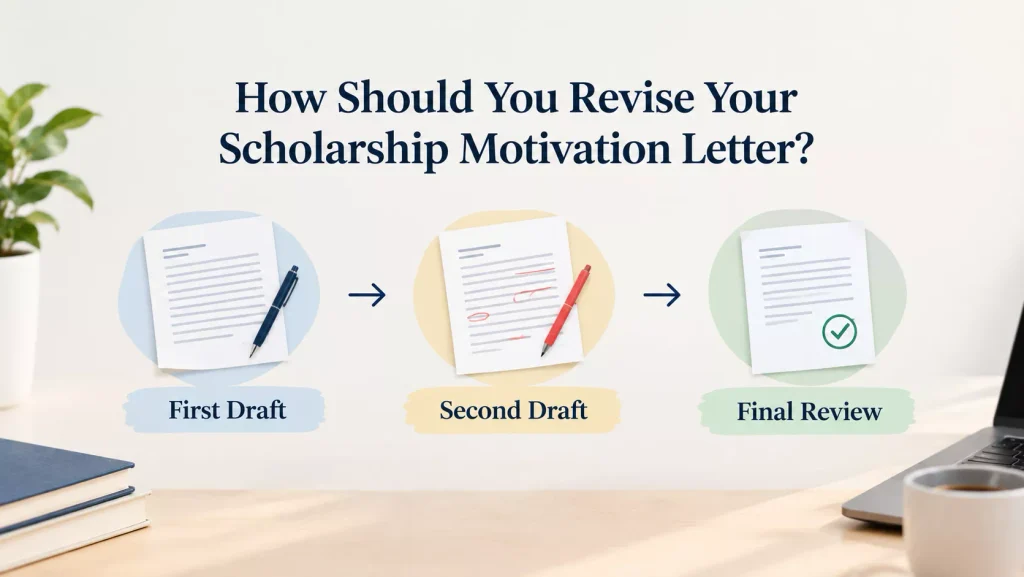
First Draft
Start by identifying your main points:
- What have you studied or worked on?
- What experience is most relevant?
- Why are you applying for this programme?
- Why are you applying for this scholarship?
- What do you want to do after graduation?
Write your first draft without worrying too much about perfect wording.
Second Draft
Remove unnecessary information and repetition. Make sure each paragraph has a clear purpose.
Check whether your examples actually support the claims you make. Replace vague statements with specific evidence wherever possible.
Final Review
Read the letter carefully before submitting it.
Check:
- spelling and grammar
- word count
- formatting
- scholarship and university names
- programme name
- required questions
- dates and other factual details
- consistency with your CV and application form
If possible, ask a trusted teacher, professor, mentor, or experienced reviewer to read the letter and provide feedback.
Prepare Your Scholarship Motivation Letter With Confidence
A strong scholarship motivation letter is not about using complicated language or making exaggerated claims. It is about presenting a clear and credible connection between your experience, academic interests, the scholarship you are applying for, and your future goals. For Pakistani students preparing scholarship applications in 2027, start early and check the official requirements for every opportunity. Tools and guidance from platforms such as ScholarBee can also help students organize their scholarship preparation and improve their application materials.
Frequently Asked Questions (FAQs)
How long should a scholarship motivation letter be?
There is no universal word count for every scholarship. The required length depends on the scholarship provider, university, or programme. Some applications specify a maximum or minimum word count, while others provide specific questions instead. Always follow the official instructions.
What is the difference between a motivation letter and a personal statement?
A motivation letter generally explains why you are applying for a particular opportunity and how it connects with your academic or professional goals. A personal statement may provide more information about your background, experiences, motivation, or personal circumstances. However, the terms can overlap, so follow the terminology and instructions used by the specific scholarship or university.
Can I use AI to write my motivation letter?
AI tools can be useful for brainstorming, organization, and grammar checks, but your application should accurately represent your own experiences and ideas. Check the scholarship provider’s instructions before using AI and never include information that is not true.
How do I end a motivation letter for a scholarship?
Briefly reinforce your motivation and future goals, thank the selection committee, and use the sign-off required for the application. For a formal letter, “Sincerely” followed by your name is appropriate.
Is it okay to discuss financial problems in a motivation letter?
If financial circumstances are relevant to the scholarship or application, you can explain them honestly and concisely. However, follow the scholarship’s instructions about financial need. Do not rely only on a hardship story; explain your academic background, goals, and reasons for applying as well.
