


The Chevening Scholarship is a UK Government scholarship programme that enables eligible applicants from around the world to study a one-year master’s degree at a UK university. The programme looks for applicants who can demonstrate leadership and influencing skills, relationship-building abilities, clear career goals, and a commitment to creating positive change.
Chevening Scholarship for Pakistani students provides an opportunity to pursue an eligible UK master’s degree with financial support that includes tuition fees, travel, a monthly living allowance, and certain other costs. Applicants must also meet Chevening’s eligibility requirements and secure an unconditional offer from at least one of their three chosen courses by the relevant deadline.
Quick Answer
The Chevening Scholarship 2027–28 is a UK Government scholarship for eligible applicants who want to study a one-year master’s degree in the UK. Applicants need at least 2,800 hours of work experience, an undergraduate degree that qualifies them for a UK master’s programme, citizenship of a Chevening-eligible country, and a commitment to return to their country of award for at least two years after the scholarship ends. For the current 2027–28 application cycle, applications opened on 4 August 2026 at 11:00 UTC and close on 6 October 2026 at 11:00 UTC.
Key Takeaways
- Chevening is a UK Government scholarship programme for eligible applicants pursuing a one-year master’s degree in the UK.
- Applicants must have at least 2,800 hours of work experience gained after completing their undergraduate degree.
- There is no upper age limit for Chevening Scholarship applicants.
- Applicants must list three eligible UK master’s courses and apply separately to the universities.
- Chevening’s own English-language requirement was removed in 2020, but applicants must still satisfy the English-language and other admission requirements of their chosen universities.
- Scholars must return to their country of award for at least two years after completing the scholarship.
What Is the Chevening Scholarship?
Chevening Scholarships are funded by the UK Government and support future leaders from eligible countries and territories to study for a master’s degree in the UK. The programme is funded by the Foreign, Commonwealth and Development Office (FCDO) and partner organisations.
Chevening assesses applications across four main areas:
- Leadership and influencing skills
- Relationship-building and networking
- Course and university choices
- Career plans and future impact
Chevening’s official application guidance states that applicants should provide clear examples of leadership, influencing others, building professional relationships, and achieving results. Applicants must also explain how their chosen course connects with their background and career plans and how their future plans can contribute to positive change.
What Does the Chevening Scholarship Cover?
Chevening provides several forms of financial support to award recipients. According to the official Chevening guidance, the award includes:
| Expense | Chevening Support |
|---|---|
| Tuition fees | Covered |
| Travel to and from the UK | Economy travel by an approved route |
| Monthly living allowance | Provided |
| Arrival allowance | Provided |
| Departure allowance | Provided |
| UK visa application | Covered |
| TB test | Contribution of up to £75 where required |
| Travel top-up allowance | Provided |
The Chevening Scholarship for Pakistani students covers accommodation and living expenses. The amount depends on whether the scholar studies in or outside London, and the rates are reviewed annually.
Who Is Eligible for the Chevening Scholarship in Pakistan?
Pakistani applicants must meet Chevening’s eligibility requirements.
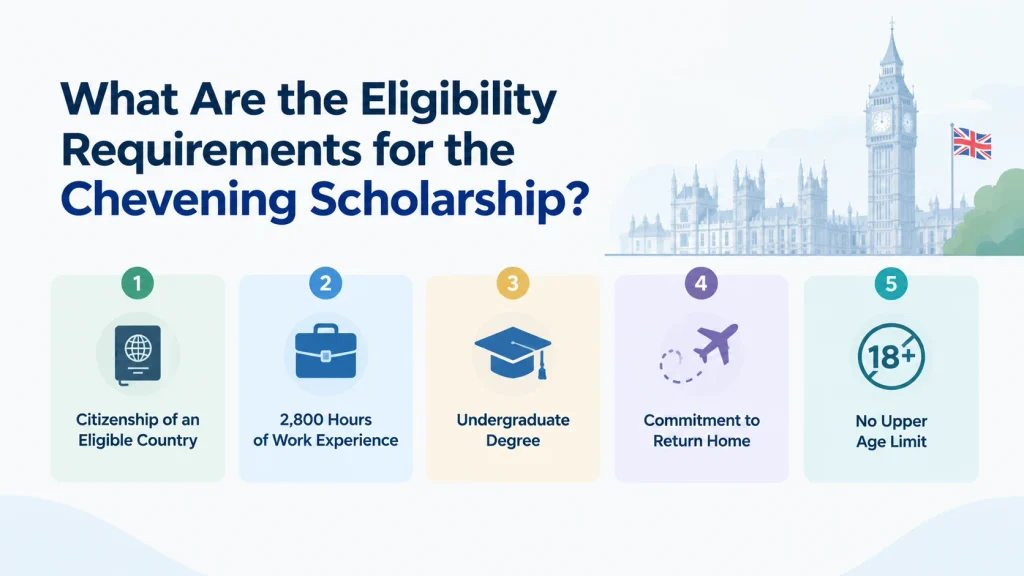
The main requirements include:
1. You must be a citizen of an eligible country
Applicants must be citizens of a country or territory eligible for Chevening. Pakistan has a Chevening Scholarship programme, and the current Pakistan page lists applications for the 2027–28 cycle.
2. You need at least 2,800 hours of work experience
You must have at least 2,800 hours of work experience, acquired after completing your undergraduate degree. This is roughly equivalent to two years of full-time work based on a 35-hour working week.
Eligible experience can include:
- Full-time employment
- Part-time employment
- Voluntary work
- Paid internships
- Unpaid internships
You can enter up to 15 different periods of employment or work experience in the application. Chevening’s system calculates your total hours using the weeks worked and hours worked per week.
For the current application cycle, Chevening states that applicants must have completed their undergraduate degree by October 2024 to meet the two-year work-experience requirement.
3. You need an undergraduate degree
You must hold an undergraduate degree that qualifies you for a UK master’s programme. For the current eligibility criteria, your undergraduate studies must have been completed at least two years before the application deadline, even if you have not yet received the certificate at the time of application. You will need the certificate by the interview stage.
4. You must commit to returning home
Applicants must commit to returning to their country of award for at least two years after their scholarship ends.
5. There is no upper age limit
Chevening does not impose an upper age limit on Scholarship applicants.
Having a master’s degree also does not automatically make an applicant ineligible for Chevening.
How Do You Write Chevening Essays?
The Chevening application includes four essay questions covering leadership, relationship-building, course choices, and future career goals. Applicants must answer the questions in English and follow the specified word limits.
1. Leadership and Influence
Chevening assesses your leadership and influencing skills. Your examples should show what you did, how you influenced others, and what results followed.
Official guidance gives examples such as driving change, improving outcomes, solving a specific challenge, or successfully implementing a project or idea with tangible impact.
2. Relationship-Building
The networking section looks at how you have developed professional relationships and worked with others to achieve positive outcomes.
Chevening asks applicants to provide examples of building relationships, bringing people together, and contributing to meaningful or measurable results.
3. Course and University Choices
You must select three eligible UK master’s courses in your Chevening application.
You should research all three choices. For the course-choice essay, Chevening asks applicants to focus on their first-choice course and explain how it connects to their background, career aspirations and intended impact. Applicants should also explain how specific modules or areas of study will provide the skills and knowledge needed to achieve their goals.
Chevening’s current guidance also asks applicants to consider how their chosen course could help address challenges connected with UK global priorities, including growth and prosperity, climate resilience, security and stability, and more inclusive and effective societies.
4. Career Plan
Your career plan should include short-, mid- and long-term goals that are clear, measurable, realistic and achievable. You should explain how your previous experience, chosen course and future plans connect and how you intend to create positive change after your studies.
Important: Chevening strictly prohibits using AI software to generate answers to its essay questions. Applicants must submit their own original work. Chevening states that applications containing copied or AI-generated answers can be disqualified.
What Courses Are Eligible for Chevening?
Your three selected courses must meet Chevening’s eligibility requirements. Eligible courses must:
- Be full-time
- Be based in the UK
- Start in the autumn term, usually September or October
- Lead to a master’s degree
- Be between nine and 12 months in duration
Courses cannot be distance learning, part-time, research-based, less than nine months long, more than 12 months long, or starting in January.
You must apply separately to the universities. Listing a course on your Chevening application does not submit an application to that university.
You do not have to apply to your selected university courses before submitting your Chevening application. However, you must eventually secure an unconditional offer from at least one of your three selected courses by the deadline in the Chevening application timeline.
How to Apply for the Chevening Scholarship from Pakistan
All Chevening Scholarship applications must be completed through the official online application system. For the 2027–28 cycle, applications opened on 4 August 2026 at 11:00 UTC and close on 6 October 2026 at 11:00 UTC. The online application system cannot be accessed after the deadline.
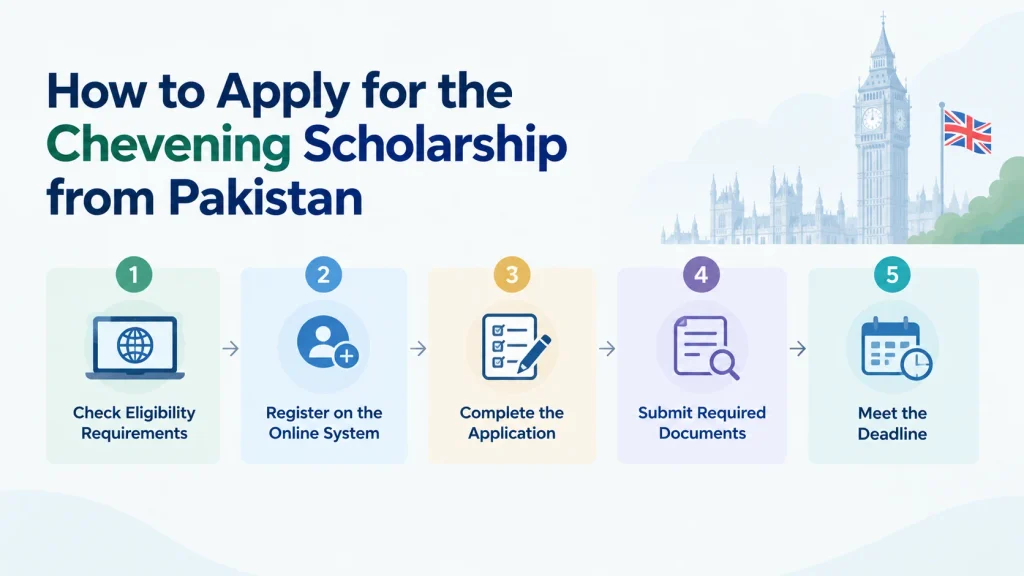
The application process includes:
- Check the official eligibility requirements.
- Register through the Chevening online application system.
- Complete the eligibility checker.
- Record your unique access code.
- Complete your personal, immigration, education and work-history information.
- Enter your three UK master’s course choices.
- Provide details of two referees.
- Answer the four Chevening essay questions.
- Complete all required sections.
- Submit the application before the deadline.
If you are shortlisted for an interview, you will need to provide the required documents and reference letters within the specified timeline.
Chevening Scholarship 2027–28 Timeline
The official Chevening timeline currently lists the following dates:
| Stage | Date |
|---|---|
| Applications open | 4 August 2026 |
| Applications close | 6 October 2026 |
| Reading committee assessments | Mid-October 2026 to January 2027 |
| Interview shortlist | Mid-February 2027 |
| Interviews | March to April 2027 |
| Results | Mid-June 2027 |
| Unconditional offer deadline | 8 July 2027 |
| Studies begin in the UK | September/October 2027 |
Do You Need IELTS for Chevening?
Chevening itself does not require an English-language test. Its English-language requirement was removed in 2020.
However, this does not mean that IELTS or another English-language test is unnecessary for every applicant. Your chosen university may have its own English-language requirements, and you must satisfy those requirements to obtain the required unconditional offer.
Always check the official requirements of each university and course you apply to.
What Happens After You Apply for Chevening?
After applications close, eligible applications are assessed by independent reading committees. Shortlisted candidates are then invited to interviews at British embassies and high commissions.
For the 2027–28 cycle, interviews are scheduled for March to April 2027, with results expected from mid-June 2027. Successful candidates must then submit an unconditional offer from a UK university by 8 July 2027.
What Happens After You Receive the Scholarship?
Once selected, scholars complete the required steps before beginning their studies in the UK. The official 2027–28 timeline states that studies will begin in September/October 2027. Chevening also provides scholars with opportunities to build connections with other scholars, alumni, the FCDO, speakers and partner organisations through its engagement programme.
After completing the scholarship, scholars must return to their country or territory of award for at least two years. This is a condition of the award.
Preparing for the Chevening Scholarship 2027–28
If you are applying from Pakistan, start by checking the official eligibility criteria and calculating your work experience carefully. You can also explore the best international scholarships for Pakistani students to compare other scholarship opportunities. Your experience must have been acquired after completing your undergraduate degree and must meet the required 2,800 hours over at least two years.
You should also research your three eligible master’s courses early because you must apply to the universities separately and eventually secure an unconditional offer from at least one selected course.
Planning Your Chevening Scholarship Application
The Chevening Scholarship gives eligible Pakistani applicants the opportunity to study a master’s degree in the UK with substantial financial support. If you are researching UK universities and scholarship opportunities alongside your Chevening preparation, Scholarbee can help you explore relevant study options, while Chevening’s official website should remain your source for current eligibility requirements, deadlines and application rules.
Frequently Asked Questions
How many hours of work experience do I need for Chevening?
You need at least 2,800 hours of work experience, acquired after completing your undergraduate degree. The experience must be gained over a minimum of two years. Eligible experience can include full-time employment, part-time employment, voluntary work and paid or unpaid internships.
Can I apply for Chevening if I already have a master’s degree?
Yes. Having a master’s degree does not automatically prevent you from applying for Chevening. You must still meet all current eligibility requirements.
Do I need IELTS to apply for Chevening?
No. Chevening removed its English-language requirement in 2020. However, your chosen university may require IELTS or another accepted English-language qualification as part of its admission process.
Do I have to return to Pakistan after Chevening?
If Pakistan is your country of award, you must commit to returning to your home country for at least two years after your scholarship ends. This is a condition of the award.
Can I choose any master’s course in the UK?
No. Your course must meet Chevening’s eligibility requirements. It must be a full-time UK-based master’s programme that starts in the autumn term and lasts between nine and 12 months. Distance-learning, part-time and research-based courses are not eligible.
Do I apply to the university through Chevening?
No. You must apply separately to each university. Listing a course on your Chevening application does not submit an application to that university.
What is the Chevening application deadline for 2027–28?
For the current 2027–28 application cycle, Chevening states that applications close on 6 October 2026 at 11:00 UTC.
