

HEC scholarships in Pakistan cover a wide range of opportunities, including undergraduate scholarships, local PhD fellowships, overseas scholarships, regional programmes, postdoctoral fellowships, and foreign-funded scholarships. However, not every HEC scholarship has a 2027 intake announced yet.
As of September 2026, HEC has already announced some scholarships for study beginning in 2027, including the Commonwealth Scholarship Programme for the 2027–28 academic year and the Seoul National University President Fellowship for Spring 2027. HEC also continues to administer established national and international scholarship programmes through its official scholarship systems.
Quick Answer
HEC offers scholarships for undergraduate, master’s, PhD, postdoctoral, and international study in different fields and categories. These include need-based scholarships, regional programmes, local PhD fellowships, and scholarships for study abroad. However, not every HEC scholarship has a 2027 intake announced yet, so students should not assume that previous-year deadlines or requirements will continue. Always check the latest official HEC advertisement for the scholarship’s eligibility, deadline, test requirements, and application process.
Key Takeaways
- HEC offers scholarships for different degree levels and student categories.
- Not every HEC scholarship requires HAT.
- Need-Based Scholarships are applied for through participating universities.
- International scholarships may require applications through HEC and the foreign provider.
- 2027 deadlines are not available yet for every HEC programme.
- Always check the latest HEC advertisement before applying.
What HEC Scholarships Are Available in Pakistan?
HEC offers scholarships across different study levels and categories. The main programmes listed in its official scholarship directory include:
| HEC Scholarship / Programme | Category | Suitable For |
|---|---|---|
| HEC Need-Based Scholarship | National / Financial Need | Undergraduate students |
| Indigenous PhD Fellowship | National / Research | PhD students in Pakistan |
| Post-Doctoral Fellowship Programme | Research | PhD holders seeking postdoctoral research |
| Balochistan & Erstwhile FATA Scholarships | Regional | Eligible students from Balochistan and erstwhile FATA |
| Gilgit-Baltistan Undergraduate Scholarships | Regional | Undergraduate students from Gilgit-Baltistan |
| Gwadar Undergraduate Scholarships | Regional | Undergraduate students from District Gwadar |
| US-Pakistan Knowledge Corridor | International / PhD | Pakistani and AJK applicants pursuing PhD study in the US |
| Learning Opportunities Abroad (LOA) | International / Foreign-Funded | Pakistani students applying for eligible overseas scholarships |
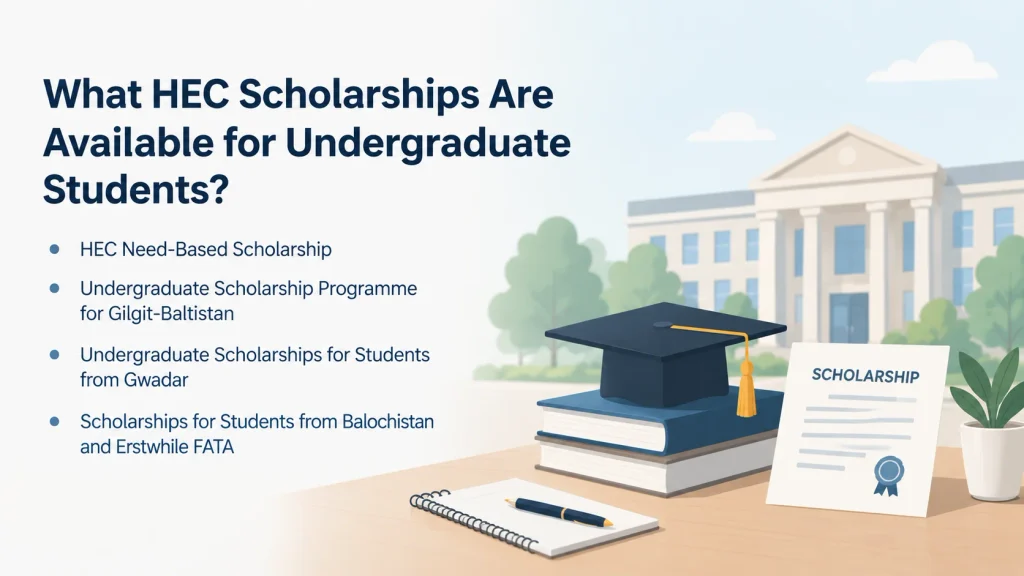
What HEC Scholarships Are Available for Undergraduate Students?
Here are the scholarship opportunities available for undergraduates
HEC Need-Based Scholarship
The HEC Need-Based Scholarship provides financial assistance to students studying at participating public-sector universities and degree-awarding institutions in Pakistan.
Students must secure admission according to the participating institution’s admission requirements and be enrolled in an eligible undergraduate programme. Students who are already enrolled can also apply if they meet the programme’s requirements. Selection is based on financial need as assessed by the university’s Institutional Scholarship Award Committee.
The current HEC eligibility information states that the programme provides university fee support and a Rs. 6,000 monthly stipend. Students admitted on a self-finance basis are not eligible.
Importantly, students do not submit the Need-Based Scholarship application directly to HEC. They obtain and submit the form, with supporting documents, through the Financial Aid Office of the participating university.
Undergraduate Scholarship Programme for Gilgit-Baltistan
HEC runs a dedicated undergraduate scholarship programme for students from Gilgit-Baltistan.
Applicants must have a valid GB domicile or local certificate and meet the academic requirements stated in the relevant advertisement. Students can apply to public-sector universities and institutions in Pakistan under the programme’s conditions.
For the programme’s selection procedure, HEC states that the Scholarship Aptitude Test carries 50% weightage, while SSC carries 10% and HSSC carries 40%. A minimum of 50% in the aptitude test is required under the cited selection procedure.
Undergraduate Scholarships for Students from Gwadar
HEC also offers an undergraduate scholarship programme specifically for students from District Gwadar.
Applicants must possess a domicile or local certificate of residence of District Gwadar and have completed 12 years of formal education or an equivalent qualification. Students already enrolled in a BS programme for no more than one academic year/session may also be eligible under the programme rules.
The cited eligibility criteria set the maximum age at 22 years on the closing date.
Scholarships for Students from Balochistan and Erstwhile FATA
HEC has a dedicated programme for students from Balochistan and erstwhile FATA.
For the undergraduate programme, applicants must have a local/domicile certificate from Balochistan or erstwhile FATA, have completed at least 12 years of education with at least 60% marks, and meet the age and other conditions in the relevant advertisement.
The programme’s official information states that undergraduate scholarship support can include tuition and other charges, hostel fees within the prescribed limit, living allowance, book allowance, travelling allowance, and an initial settlement allowance, subject to the programme’s approved terms.
Important: The latest specific batch shown on HEC’s programme page had a 2025 application deadline. Do not assume that deadline or its batch-specific details apply to a future 2027 intake. Students should wait for the next official HEC advertisement.
What HEC Scholarships Are Available for Master’s and PhD Students?
HEC scholarships available are as follows:
Indigenous PhD Fellowship Programme
The Indigenous PhD Fellowship Programme supports Pakistani and AJK nationals pursuing PhD-level study in Pakistan under HEC’s approved programme conditions.
The current eligibility information requires Pakistani/AJK nationality and at least 16 years of education, with no third division or Grade D in the academic record. Additional academic requirements apply to candidates applying for direct PhD scholarships.
The maximum age is generally 35 years, with a 40-year limit for specified regular faculty and public-sector/R&D employees. Applicants already receiving another HEC or government scholarship are not eligible.
HEC’s programme documentation also provides financial support for scholars and universities, including stipend and research-related support. The exact financial terms depend on the applicable phase and policy.
Overseas Scholarships for MS/MPhil Leading to PhD
HEC also runs overseas scholarship programmes for MS/MPhil and PhD study in selected fields.
The latest official Phase-III information covers scholarships for study at HEC-identified top-ranked foreign universities and states that the programme is intended to develop highly qualified human resources in strategically important disciplines.
The latest batch shown by HEC had a 28 August 2026 application deadline, so that deadline should not be presented as a 2027 deadline.
For a future 2027 intake, applicants should rely on the new HEC advertisement when it is published.
What International Scholarships Does HEC Offer?
HEC’s Learning Opportunities Abroad (LOA) system publishes foreign-funded scholarship opportunities received through diplomatic channels.
HEC currently states that valid HAT scores are accepted for master’s and PhD programmes, while USAT scores are used for bachelor’s-level foreign-funded opportunities, depending on the scholarship.
HEC specifically mentions programmes such as Commonwealth, Hungarian and Chinese government scholarships within its LOA system.
The important point is that these scholarships are not all available at the same time. HEC marks opportunities as active or inactive as their application periods change.
For students exploring other international funding opportunities, see Best International Scholarships for Pakistani Students in 2026.
Commonwealth Scholarship Programme 2027–28
The Commonwealth Scholarship Programme is one of the HEC opportunities with a confirmed 2027 intake.
For Pakistan, HEC is the national nominating agency. The scholarships cover full-time taught master’s and PhD study in the UK beginning in September/October 2027.
The current HEC announcement gives the following deadlines:
- HEC deadline: 20 October 2026 at 4:00 PM Pakistan Standard Time
- CSC deadline: 20 October 2026 at 4:00 PM BST
- Expected nomination: December 2026
- Expected results: July 2027
- Expected study start: September/October 2027
Applicants must apply through both the HEC and Commonwealth portals. HEC requires a minimum HAT score of 60 out of 100 for this programme.
For the Pakistan-specific application process, see Commonwealth Scholarship from Pakistan: How to Apply in 2027.
US-Pakistan Knowledge Corridor
The US-Pakistan Knowledge Corridor is an HEC PhD scholarship initiative for study at eligible US universities.
The current HEC eligibility information requires applicants to be Pakistani/AJK nationals with at least a four-year bachelor’s degree or 16 years of formal education.
The age limit is generally 35 years, increasing to 40 years for specified government employees, public-sector university faculty, and researchers.
Applicants must also meet the programme’s academic and university-ranking requirements.
For the current categories, HEC’s published criteria refer to admission to top-ranked US universities and require either a qualifying GRE score or a minimum HAT score of 60%.
The scholarship can cover a maximum period of five years under the published programme instructions, and successful scholars are required to meet HEC’s service/return obligations.
The previous claim that US universities “usually drop the tuition fee” should not be used as a general rule. Funding arrangements should be checked against the official HEC scholarship terms and the individual university offer.
Other Learning Opportunities Abroad
HEC periodically publishes government-funded scholarships from countries including Hungary, China, Azerbaijan, Morocco and other partner countries.
However, students should not treat these as permanently open 2027 scholarships. HEC archives each opportunity after its application cycle.
For example, the 2026–27 Stipendium Hungaricum programme is now listed in HEC’s inactive/archive section.
As of September 2026, HEC has also announced other opportunities connected to 2027 study, including the Swiss Government Excellence Scholarships 2027–28 and the Seoul National University President Fellowship for Spring 2027. These have their own eligibility criteria and application routes.
What Scholarships Are Available for University Faculty and Fresh PhDs?
Scholarships available for university faculty and fresh PhDs are as follows:
Faculty Development Programme
HEC’s Faculty Development Programme supports the academic and research development of university faculty. According to HEC’s April 2026 update, the programme has awarded around 300 scholarships, with more than 110 scholars having completed their PhDs.
The programme has included faculty members pursuing doctoral research in Pakistan followed by a research placement abroad of six to twelve months at highly ranked universities. The exact eligibility and intake depend on the relevant batch and participating institutions, so applicants should check the latest HEC announcement rather than relying on older programme descriptions.
Post-Doctoral Fellowship Programme Phase-III
HEC’s Post-Doctoral Fellowship Programme Phase-III provides postdoctoral research opportunities.
HEC states that the programme offers 1,000 fellowships over five years on open merit at the national level. The published allocation includes 70% of slots for faculty members of public-sector universities and institutes, 15% for private universities, and 15% for public-sector R&D organisations recognised by the Pakistan Council of Science and Technology.
Applicants also need an appropriate research proposal and a valid invitation or acceptance letter from a relevant university meeting the programme’s ranking requirements.
Interim Placement of Fresh PhDs
The Interim Placement of Fresh PhDs (IPFP) programme is different from a traditional degree scholarship. It provides fresh PhD graduates with an opportunity to gain academic experience and mentorship for one year in eligible higher education institutions, government postgraduate colleges or public-sector R&D organisations.
The programme should therefore be understood as a post-PhD placement and professional development opportunity, not as a scholarship for starting a new PhD.
Are USAID and BISP Scholarships Currently Open Through HEC?
The previous version of this article listed USAID and BISP programmes as current HEC scholarship options. The latest HEC information does not support presenting them as active 2027 programmes.
HEC’s official page for the USAID-funded Merit and Needs-Based Scholarship Programme currently states that the programme is closed for new scholarship intake.
Similarly, the current HEC scholarship directory does not establish the previous claim about a separate active BISP undergraduate scholarship as a current 2027 HEC intake. It is therefore better to leave that claim out unless HEC publishes a new official announcement.
Do You Need an HEC HAT Test for Every Scholarship?
No. The HAT is not a universal requirement for every HEC scholarship.
For example, HEC’s Learning Opportunities Abroad page states that HAT is used for master’s and PhD foreign-funded scholarship programmes, while USAT is used for bachelor’s-level foreign-funded opportunities. Individual scholarship advertisements can impose additional test requirements.
The Commonwealth Scholarship 2027–28, for example, specifically requires applicants to provide a HAT score of at least 60/100. The Indigenous PhD Fellowship and other programmes have their own eligibility and testing rules. Always check the specific advertisement before registering for a test.
How Should You Apply for an HEC Scholarship?
The application process depends on the scholarship. For programmes using the HEC scholarship system, applicants generally need to create or complete their profile and submit the relevant online application through the portal specified by HEC.
The Indigenous PhD Fellowship, for example, instructs applicants to register or log in to the HEC e-portal, complete their profile, select the relevant scholarship and submit the application.
For HEC Need-Based Scholarships, the process is different. Applicants submit the scholarship form and supporting documents to the Financial Aid Office of the participating university, not directly to HEC.
For international opportunities, applicants may also have to apply directly to the foreign scholarship provider or university. The Commonwealth 2027–28 programme, for example, requires applications to both the CSC and HEC portals.
Where Can You Find the Latest HEC Scholarship Announcements?
The safest source is the official HEC Scholarships and Grants section and its current announcements. HEC maintains separate pages for national scholarships, international scholarships, Learning Opportunities Abroad, postdoctoral fellowships and special initiatives.
Its LOA system also separates active opportunities from archived scholarships. Because scholarship deadlines and eligibility conditions change from one intake to another, students should always read the latest advertisement before applying.
Stay Updated on HEC Scholarships for 2027
HEC offers scholarship and fellowship opportunities for different stages of higher education, from undergraduate study in Pakistan to PhD, postdoctoral research and international study. For 2027, students should rely on the latest official HEC announcements rather than previous-year information. ScholarBee can help students discover scholarship opportunities, while HEC remains the final source for official requirements.
Frequently Asked Questions
Can I apply for more than one HEC scholarship?
Eligibility depends on the individual scholarship. Some HEC programmes specifically state that applicants already receiving another HEC or government scholarship are not eligible. For example, this condition appears in the Indigenous PhD Fellowship and several regional scholarship programmes.
What is the age limit for HEC scholarships?
There is no single age limit for all HEC scholarships. The limit depends on the programme. For example, the current Indigenous PhD Fellowship criteria specify 35 years for most applicants and 40 years for specified regular faculty and public-sector/R&D employees.
Do I need IELTS or TOEFL for HEC international scholarships?
There is no single English-language test rule for every HEC international scholarship. Requirements depend on the specific scholarship and the host university.
Is HAT compulsory for HEC scholarships?
No. HAT is not automatically compulsory for every HEC scholarship. HEC’s LOA system states that HAT is used for master’s and PhD foreign-funded opportunities, while USAT is used for bachelor’s-level opportunities under the relevant foreign-funded scholarship system. Individual programmes can set their own requirements.
How long does HEC take to process a scholarship application?
There is no single official processing period that applies to every HEC scholarship. The timeline depends on the programme, the number of applicants, testing, shortlisting, nomination, university admission, and, for international scholarships, the foreign scholarship provider’s final selection process.